



Walt Disney once famously opined that, “Of all the things I’ve done, the most vital is coordinating those who work with me and aiming their efforts at a certain goal.” That philosophy and its wholehearted embrace of teamwork seems to be at the heart of everything they do at the Disney Institute.
Founded in the 1980s at the Walt Disney World Resort in Florida, the Disney Institute was originally known as Walt Disney World Seminar Productions. In the beginning the sole focus was on servicing the increasing numbers of requests that Walt Disney World received from other companies wanting to take a peek behind the proverbial curtain at the park, to see how things worked from a business and operational standpoint.
Today the Disney Institute focuses on delivering its services to business leaders, professionals, companies and organisations around the world by offering them the opportunity to learn how Disney delivers an exceptional customer experience (CX) in its parks and resorts through employee engagement, quality service, and business and leadership excellence.
Currently headquartered in Celebration, Florida – an idyllic, masterplanned community just a few miles from the Magic Kingdom itself – the Disney Institute’s reach, like that of the Disney brand, is global, with regional offices in California and as far away as Hong Kong.
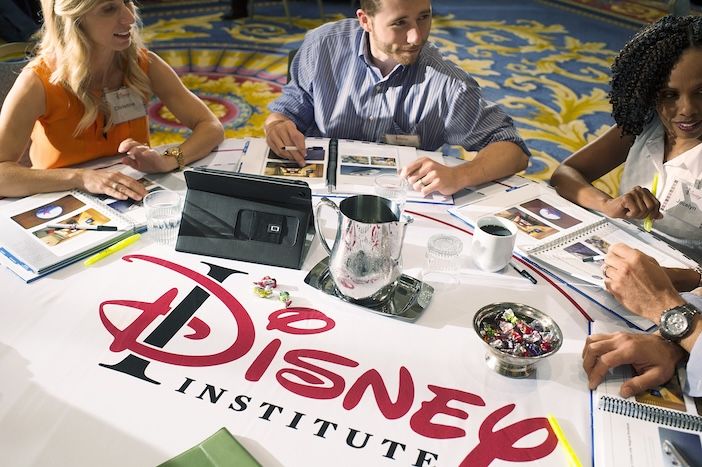
“Our team travels the globe to deliver training and advisory services to companies and organisations at their home-office headquarters, satellite offices, retail locations, sporting and entertainment venues, etc,” says Jeff James, longtime vice president and general manager of the Disney Institute. “On any given day we might have professional development courses running in Florida and California, as well as on-site meetings, deliveries and program roll-outs at our client locations worldwide.”
[Editor’s note: Jeff James was also one of the original founding executives of Disney Cruise Line. He is now a speaker and consultant and has presented at major conferences around the world for clients including Delta Airlines, NBA, Qualtrics, and numerous Disney leadership events.]
And though the finer points of offering top-notch customer service may vary a bit from company to company and region to region – and the Disney Institute makes a point of not commenting on specific industries as its expertise is CX – James says the desire for a more authentic and personalised CX is universal.
“People are looking for an authentic, individualised and unexpected experience, something that surprises and delights them,” explains James. “When customers feel that they’re treated as individuals, they are more likely to perceive their experience as unique and special. We teach our clients that their customer service, though carefully architected in advance, should look and feel spontaneous and personalised when delivered in the service moment.”
This is particularly important in the age of social media, where the artful use of branding and social media listening tools offer forward-thinking companies (and/or airlines) the ability to react to negative customer experience situations, often in real time, via social media.
“You need to focus on creating an authentic experience at every touchpoint – each and every moment where a customer interacts with your brand, product or service – and you need to consistently deliver on your brand promise over and over again,” explains James.
“It really boils down to just one thing: being purposeful about the details. Be intentional with everything you do, every process you create and every action you take. And then don’t just set it and forget it. Always be re-evaluating, adjusting, measuring and retraining employees on desired behaviours. CX bells and whistles alone can’t create enduring success, but aligned employees creating genuine connections with your customers is something that can stand the test of time.”

And though the rise of AI and automated solutions on the retail and travel front seem to be changing the way we eat, shop and even check-in for our flights at airports, James insists that when it comes to world-class CX, nothing can ever really take the place of the human touch.
“It’s hard to open a business magazine without seeing some mention of automation, but I contend that business leaders cannot forget the ‘software’ side of their industry – that is, the people or cultural aspects of what all these changes will mean for customers and employees.”
“At the Disney Institute, one of the key business insights is based on the importance of making emotional connections with customers,” says James. “We’ve seen time and time again that those connections are key to driving customer loyalty, and you just can’t get that from fully automating the customer experience. We believe that automation is a tool to enhance CX, but it should never completely eliminate the opportunity for your people to make emotional connections in the customer journey.”
And when it comes to predicting the future of CX in the digital age, James circles back to the growing demand for personalisation and the rise of individualised CX. Considering the fact that Virtuoso’s annual Luxe Travel Report recently named 2019 ‘The Year of Ultra-Personalised Travel’, this seems pretty accurate for the airline industry as well.
“As technology evolves, and customers and organisations learn about each other much more rapidly, their ability to respond to each other will continue to become more sophisticated,” says James. “That’s why business leaders must move beyond just trying to appeal to a specific market segment and instead recognise and appeal to their individual customers. In the future, I believe success will continue to be found in differentiating your brand, product or service, and also in your ability to individualise the customer experience.”
Or, as they like to say at the Disney Institute, treat every customer/passenger like a VIP – a Very Individual Person – and take it from there.
3 top ways to achieve stellar customer experiences (CX)
Jeff James shared the Disney Institute’s wide-ranging insights in offering top-notch CX. They are:
- “First, you should have an organisational common purpose, a succinct explanation of what you want the CX to be at the emotional level. This is the foundation on which all service decisions and desired behaviours can be developed. For employees, this represents what you stand for and why you exist, and it’s the primary tool for getting everyone on the same page to display specific behaviours. Leadership plays a critical role. Leaders must align their behaviours to consistently uphold the common purpose, serving as a role model for everyone in the organisation.”
- “Next, you need to understand your customers holistically. Your knowledge of the customer must extend beyond traditional service criteria. You need to create a consistent process to gather customer feedback and truly listen to what they have to say.”
- “You must view exceptional service as an economic asset, rather than an expense. The return on investment associated with lifetime customer relationships can more than justify the short-term costs associated with designing and delivering exceptional service experiences.”
The top 3 most common customer experience (CX) mistakes
These are the top three CX mistakes the Disney Institute sees, according to Jeff James:
- “Some organisations view service as a ‘nice-to-have’ rather than as an economic asset. In other words, leaders don’t genuinely care about customers and providing great service, so service is simply seen as a means to a financial end. We know that undervaluing service leads to underinvesting in service.”
- “Another common mistake is thinking of service as purely external (something you do only for external customers) and focusing on that, while leaving internal service (what you do to assist your colleagues and internal partners) to chance. Internal service is just as critical as external service, and in fact excellent internal service is what makes excellent external service possible.”
- “Getting lost in the process details is another mistake, forgetting why the process was put into place to begin with. Over time, misaligned processes can truly erode your CX. Commit to reviewing your policies and processes regularly to ensure they remain consistent with your overall service strategy.”
The 3 most important things to consider when hiring CX staff
“We always say that you must find people with a genuine desire to serve others, those with a ‘heart for service’. And a lot of times, the next question we hear is: ‘But, how?’ It starts by being extremely intentional during your hiring process.”
Here are 3 quick tips from Jeff James:
- “Clearly define the behaviours that describe your ideal employees. Then, design every step of your hiring process specifically to getting those people. For example, will your hiring leaders exemplify these same behaviours to candidates throughout the hiring process?”
- “Immerse candidates in the organisation’s culture from the very start, during the recruiting, hiring and on-boarding phases. By providing them this exposure early on, this knowledge can help them self-select in or out of the process, which can be highly efficient for both the candidate and your organisation.”
- “Look beyond the likeability factor, and hire for a clearly defined set of behaviours and technical skills. Ask questions that try to discover the candidate’s personal values and behaviours. For example, how might they handle specific customer-facing scenarios?”
About the author

Tomás Romero (1969-2023) was an author, poet, and award-winning screenwriter-producer from Los Angeles. As well as teaching screenwriting at UCLA Extension, he also wrote screenplays, feature stories, news and opinion pieces, celebrity profiles, and film reviews for magazines, digital media, Hollywood studios and everything in between.
His clients included Aircraft Interiors International magazine, MTV, Paramount, Sony, 20th Century Fox, and Telemundo.