

Airbus is focusing on ramping-up production, aiming to deliver new aircraft in less time without compromising worker safety or product quality. The airframe manufacturer has decided the solution isn’t just to hire more production staff, but instead to provide its existing staff with a smarter set of tools, including time-saving robots, so they can focus on more skilled tasks.
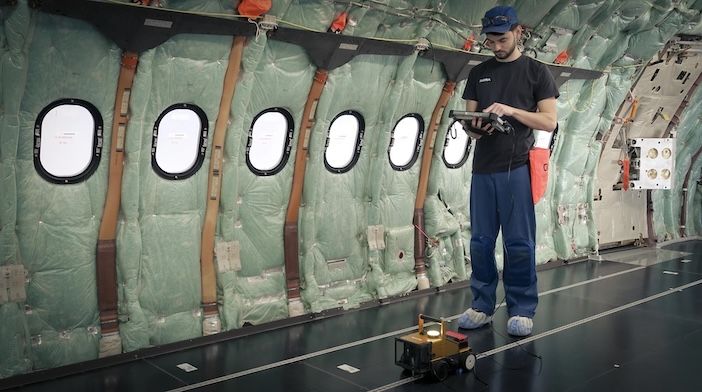
One task that is uncomfortable and repetitive for human operators is the fitting of seat tracks in the cabin. Workers spend hours bending, kneeling and crawling on the cabin floor to mark and position seat tracks. It is a slow, repetitive and physically demanding process, and one that Airbus identified as a task that should be automated so shop floor operators can focus on more complex, high-value tasks.
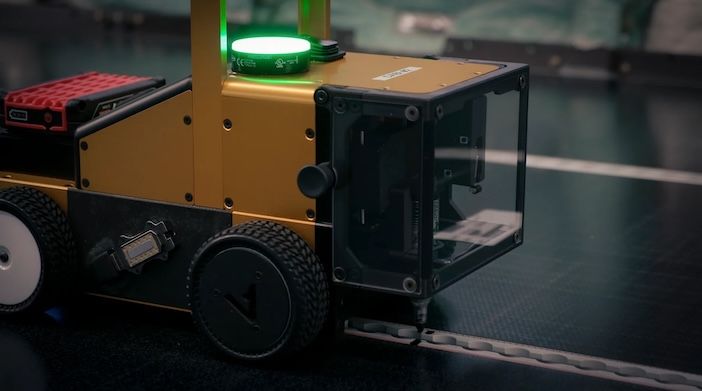
The latest production asset at Airbus is CabinMarker, a compact robot that weighs just four kilograms but could have a big impact in Airbus facilities. CabinMarker’s primary mission is to automate the positioning of aircraft seats. The robot can glide through the cabin with pinpoint accuracy, marking and positioning seat tracks. This task takes an operator 150 minutes on average, while CabinMarker can complete the task in just 30 minutes.
Airbus says the robot creates a triple win: increased quality and precision (tests of CabinMarker show it reduces rework), improved ergonomics (it helps preserve the health, backs and knees of workers), and a big time saving in production. And since only a handful of operators are needed to drive the robot, this frees-up staff resources to concentrate on higher-value tasks that contribute directly to the production ramp-up.
You can see CabinMarker in action HERE.
Global roll-out and future applications
CabinMarker is about to prove its operational worth. In late 2026, the first two robots will be delivered to Airbus’s Jean-Luc Lagardère A321 final assembly line (FAL) in Toulouse, France. They will be used to fit seats on board the A321XLR.
Airbus also plans to roll out CabinMarker across other aircraft assembly facilities (at an average of two machines per line, as seat fitting is not a constant activity), including the A330 FAL in Toulouse, where testing of the robot has already taken place.
This twin-aisle application could require a slight modification to CabinMarker’s design as the robot is sized for Airbus single-aisle aircraft, which are assembled in France, Germany, China, Canada and the USA.
Where did CabinMarker come from?
Airbus formed a new division in 2023, named Airbus Robotics. This division brings robotic expertise in-house at Airbus, with the goal of creating technology rather than buying it, and developing industrial technologies engineered by people who truly understand the needs of aircraft production.
The robot was originally developed as a prototype by Airbus’s ProtoSpace division in 2018. The technology has been further refined and industrialised since a pause during the pandemic, and now forms part of the portfolio of Airbus Robotics. Following a rigorous development phase, CabinMarker received official industrial certification in December 2025, and is now the first robot to be fully industrialised in-house by Airbus Robotics.
Further tasks have been identified for CabinMarker. The robot is mobile and lightweight, which makes it versatile. Airbus engineers are already looking at ‘V2’ applications. For example, by swapping its marking pen for a camera, CabinMarker could become an automated corrosion detection scout. Add a vacuum and tape mechanism, and it could automate the tedious process of cleaning and taping aircraft floor rails.
If you would like to see CabinMarker in action, it will make its public debut during demonstrations at the ILA Air Show in Berlin later this month.