

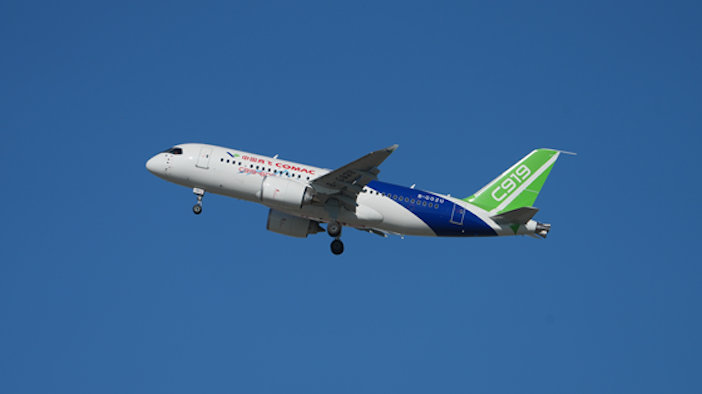
A new industry report predicts that the global in-service fleet of COMAC C919 narrowbody commercial jets will grow more than tenfold, from 31 aircraft in 2025, to 322 by 2030. The report’s author is David Walsh, an aviation analyst at the IBA aviation consultancy, who believes the growth will be created as the Chinese aircraft manufacturer accelerates production and works to convert its substantial order book into deliveries.
Annual C919 deliveries are forecast to rise from 15 aircraft in 2025 to 93 by 2030, while IBA says that COMAC’s total commercial in-service fleet, including the C909 regional jet, is expected to more than triple, from 205 to 704 aircraft, over the same period.
According to IBA’s report, titled ‘Can COMAC Convert Orders into Aircraft?‘, COMAC has moved beyond the challenge of generating demand for its aircraft, with the focus now shifting towards its ability to scale production. COMAC reports that it has taken more than 1,000 firm orders for the C909 and C919, which rises to more than 1,500 aircraft when letters of intent and memoranda of understanding are included.
The scale of the production challenge was highlighted in 2025, when around 15 C919 aircraft were delivered against an initial target of 75. IBA’s analysis indicates that the shortfall reflected a combination of supply chain and production factors, including the temporary suspension of US export licences for CFM LEAP-1C engines.
However, IBA expects that the production ramp-up will accelerate significantly over the coming years. COMAC entered 2026 with an assembly rate of approximately one C919 every 10 to 15 days, and has outlined ambitions to reach annual production of 150 aircraft by 2028 and 200 by 2029, supported by a second final assembly line and a RMB44 billion (US$ 6.52 billion) investment from eight Chinese state-owned enterprises.
IBA forecasts it will make 59 C919 deliveries in 2028, rising to 93 in 2030, alongside a steadier C909 production rate of around 50 aircraft annually. Total annual COMAC commercial aircraft deliveries are expected to reach 106 in 2028, and 146 by 2030.
International demand for COMAC aircraft
International demand is also beginning to broaden beyond COMAC’s predominantly Chinese customer base. The C909 is now operated by carriers including TransNusa (Indonesia), Lao Airlines (Laos), and VietJet (Vietnam), while Air Cambodia firmed up an order for 20 C909s in July 2026, marking the largest foreign flag-carrier commitment in the programme’s history.
The C919 is also attracting overseas interest, as shown when Brunei-based GallopAir signed a letter of intent covering 30 C909 and C919 aircraft at the 2026 Singapore Airshow.
IBA expects international certification to be the key inflection point for the C919’s longer-term global prospects. The aircraft received its Chinese CAAC type certificate in 2022, while EASA’s (the European Union Aviation Safety Agency) validation process reached a significant milestone in late 2025 when EASA test pilots flew the aircraft in Shanghai.
IBA’s view is that EASA certification is a question of when rather than if, with validation currently expected within a 2028 to 2031 timeframe. Until that point, however, the C919’s residual values and secondary-market liquidity remain relatively untested, limiting its addressable international market and leaving it closer, for now, to the A220 and E-Jets than the established Airbus 320 and Boeing 737 narrowbody programmes.
IBA predicts that COMAC will maintain a steady ramp-up of domestic production through 2026 and 2027, accompanied by incremental export growth across South-East Asia and progress towards EASA certification. The principal risks to this outlook remain the pace of production scaling, continued access to critical Western-supplied components, and the geopolitical environment governing those supply chains.
With demand already established, IBA believes the defining test for COMAC over the remainder of the decade will be whether it can convert its order book into a large, internationally certified and increasingly global in-service fleet.
IBA’s analysis is available here.