

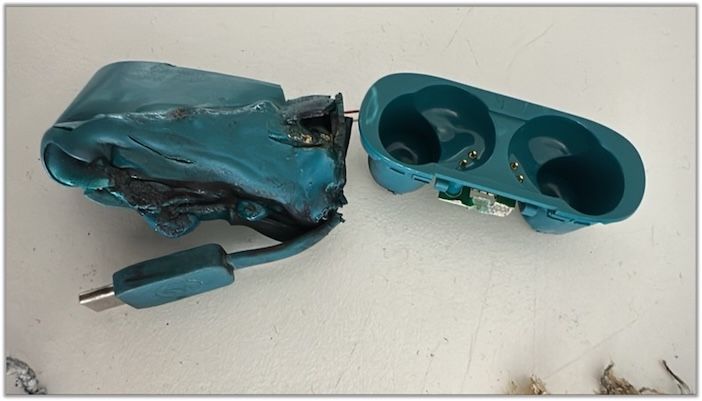
On Monday, 27th July, Swiss International Air Lines (SWISS) flight LX16 from Zurich to New York was rerouted to Bangor Airport in Maine, USA. The reason was smoke in the cabin. The cause? A charging case for wireless headphones.
A technical team that SWISS sent to Bangor to inspect the aircraft discovered that the charging case had slipped into the mechanism of a business-class seat and became trapped. As a result, the device was damaged, heat was generated by the lithium batteries, and smoke was produced.
Many modern electronic devices taken on board aircraft by passengers contain lithium batteries. If the batteries are damaged or do not work properly, they can overheat and, in the worst case, cause a fire.
SWISS notes that in the instance of the small charging case that caused the smoke issue on flight LX16, the device had a comparatively low battery capacity. Larger power banks used to charge devices such as smartphones and tablets have significantly more capacity, and a damage or malfunction can have much more serious consequences.
The cockpit crew on flight LX16 responded to the smoke event according to the procedures and training they practice in cabin simulators. SWISS flight attendants receive extensive training that covers the handling of fire, smoke and potentially dangerous objects such as power banks.
Special fireproof “lithium safe” bags are carried on every flight, for the safe containment of any devices exhibiting overheating or inflation. In this instance, due to the headphone charging case being inaccessible, the crew decided
The safest course of action was to divert to the nearest suitable airport immediately, where the ATC at Maine treated the landing as high priority.
SWISS stresses that this incident highlights the importance of continuing to raise awareness of the risks of power banks. ‘Our passengers share responsibility for safety and we must be able to rely on them strictly adhering to the power bank rules’, said the airline in a statement.
Passengers with SWISS, and indeed any airline, have responsibility for ensuring they play their part in flight safety. SWISS has strict rules in place for electronic devices brought on board, especially power banks.
The key rules for power bank safety are:
- The use of power banks on board has not been allowed since the beginning of this year.
- Thus, electronic devices or batteries may not be charged using a power bank. (Ask crew about the safe device charging options on board instead).
- Charging of power banks is not permitted.
- You are allowed to take power banks on a flight, but only a maximum of two per passenger.
- Power banks must be stowed either on the passenger’s body, in the seat pocket in front, or in the hand luggage under the seat.
- It is forbidden to carry power banks in checked baggage or to stow them in the upper hand baggage storage compartment.
- The same rules apply to e-cigarettes.
Passengers on SWISS flights also receive a reminder of these rules in the pre-take-off safety video. The video explicitly instructs passengers to inform cabin crew immediately if an electronic device heats up, emits smoke, is damaged, or gets lost under a seat. Detailed information on the safe carrying of electronic devices can also be found on the SWISS website,
‘The entire crew of flight LX16 deserves a big thank you: they acted promptly, purposefully and correctly,’ added the SWISS statement. ‘Safety is always our top priority. This also includes precautionary measures such as an alternative landing in order to react immediately to possible dangers.
The rules for safe handling of power banks on board are as clear and simple as the reasons why they are required. Please take note: the rules are there for everyone’s safety, and could prevent a time-consuming flight diversion (or worse).