


Mat Hunter, chief executive of the Design Council, has shared data that highlights the strength of the UK’s design sector, and issued some thoughts that may reassure anyone concerned about artificial intelligence (AI) replacing designers’ jobs.
The Design Council is an independent charity that supports and promotes the UK’s design industry and the 1.97 million people working in the UK’s design economy. Speaking to The Guardian newspaper, he noted that while AI is being used as a tool by designers, they are using it to add value rather than as a means to reduce staff counts.
“We are aware that technology always displaces people with new ways of working. However, we believe in the imagination and inventiveness of designers to find opportunities,” Hunter told The Guardian. “We believe the UK needs more professional designers, so overall employment should continue to grow.”
The article also noted that the skill, experience, empathy and deep understanding of human designers cannot be replaced by AI tools.
The value of design to the UK economy
The findings published in Design Economy 2026, the Design Council’s newest industry study, illustrates the high value of the sector to the UK economy. The report also states that strengthening design capability will be critical to delivering economic growth across the UK.
The study found that the design sector contributed £136.7 billion to the UK economy in 2023, which is equivalent to 5.5% of UK Gross Value Added (GVA). That means the design industry contributed around £1 in every £20 generated.
Indeed, the Design Economy 2026 study found that design has overtaken the retail sector as biggest contributor to the UK economy. Overall, the design economy grew by 40% between 2019 and 2023, compared with 24% growth across the wider UK economy.
Its contribution is now larger than the UK’s entire retail sector, which is worth £114 billion, and nearly twice the size of the accommodation and food service industry, which is worth £70 billion. While inflation was unusually high over the period, the figures show the increasing economic importance of design across the UK.
The report (available here) also shows that UK design has significant international reach. Design service exports reached £71 billion in 2022 – up from £56 billion in 2019 – and represented 17% of all UK service exports. That figure is equivalent to around 77% of the value of the UK’s financial services exports. Digital design accounts for more than £50 billion of these service exports, reflecting growing international demand for the UK’s digital design capability.
The United Kingdom has the world’s largest concentration of aircraft interior design studios, and their innovations are flying with airline clients around the world. The March issue of Aircraft Interiors International features the story behind the studios.
The value of people
The Design Council has also noted increases in productivity. It says that, in 2023, productivity among designers working inside and outside the design industries was estimated at £60,704 per person, up around 18% from 2019. Product and industrial design generated the highest economic value per employee, at £96,200.
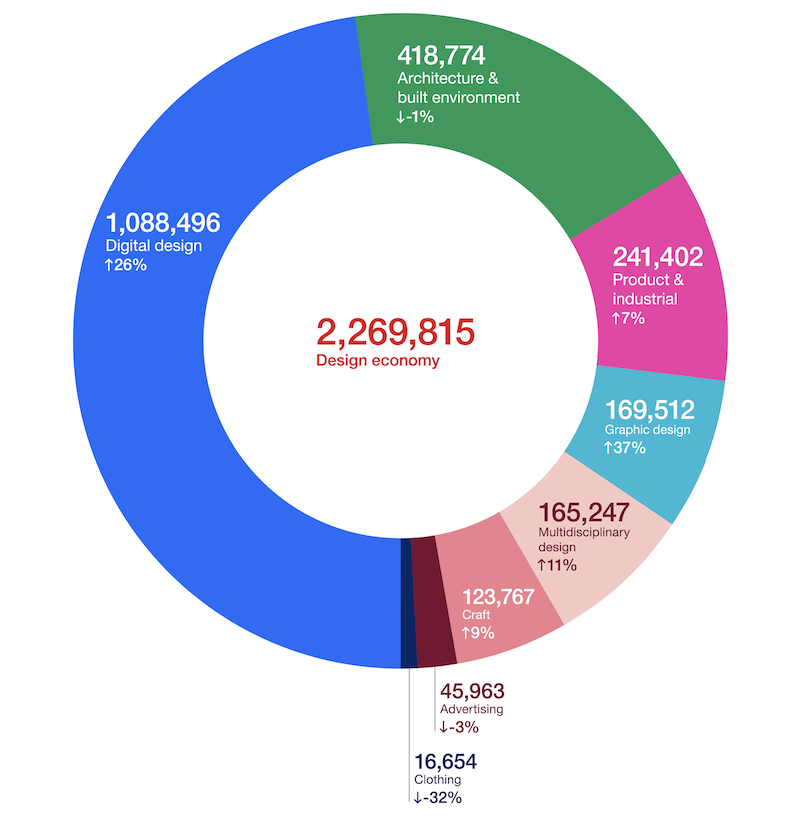
There has also been employment growth in the UK design sector. More than 2.27 million people were employed across the UK design economy in 2025, which is an increase of 15% since 2020 (approximately 297,000 more jobs) while total UK employment grew by less than 2.5% over the same period. Of those working in the design economy, around 1.88 million are employed in design occupations, which now account for 6.2% of all UK employment.
However, the report warns that future growth cannot be taken for granted. Entries for Design and Technology GCSEs (academic qualifications taken by students aged 14 to 16 in England, Wales, and Northern Ireland) fell by 68% over the decade to 2024, which could indicate a potential issue in the future skills pipeline at a time when businesses need design capabilities to respond to rapid technological change, including AI.
The Design Council also notes that progress on workforce diversity remains slow. Women account for only 25% of designers, while Black designers make up 2% of the design workforce compared with 5% of the wider UK working population.
“These figures should change the way we think about design,” stated Mat Hunter. “It is not a niche creative activity sitting at the edge of the economy; it is a £136.7 billion capability embedded in the way organisations effectively innovate, tackle complex problems, and grow. The opportunity now is to make sure that capability is available everywhere – in businesses and public services, across every region and nation – and that we invest in the skills and diversity needed to sustain it for the future.”