

The airline passenger experience industry is increasing its efforts to address the diverse needs of travellers, with a current focus being the neurodivergent population.
We spoke with three industry experts about how cabin design and the wider passenger experience is evolving to reflect the full spectrum of the travelling public, including the more than 15% of which who identify as neurodiverse.
Raising the bar for an inclusive passenger experience
Growing awareness of the requirements of neurodiverse passengers is reshaping expectations across the aviation industry. Jo Rowan, associate director of strategy at the PriestmanGoode design studio notes, “A significant portion of the population is neurodivergent, so there is a good understanding and often first-hand experience of what makes spaces and experiences work better for them.”

Work in this area is being accelerated by generational change. “Gen Alpha is really focused on fairness and inclusion, growing up in a connected, diverse, and socially conscious world that demands transparency,” she adds.
At the same time, airlines are facing increasing pressure to stand out through passenger experience. “There is growing pressure for airlines to differentiate through exceptional passenger experiences… meaning we must respond to the needs of all passengers,” Rowan explains.
Craig Kennedy is programme and training manager at Open Doors Organization, a non-profit working to make the transportation and hospitality industries more4 accessible. He states, “When airlines were founded, it was all about customer service and having an amazing experience. People are people, no matter where we sit on the spectrum of neurodiversity.”
He is clear that accessibility should not be viewed as an add-on: “We are all paying customers and we all have needs of some sort,” states Kennedy.
These perspectives point to a fundamental change. Designing for diverse needs is no longer about special accommodation, but about delivering a better, more consistent experience for all.
Rethinking the cabin
The aircraft cabin is one of the spaces where the shift towards more inclusive experiences in air travel is becoming most tangible.
For Jo Rowan, this starts with a key principle: “What one passenger finds calming can be overstimulating for others… it is important to consider the full spectrum of needs, holistically.”
Designing for neurodiversity, therefore, is not about a single solution, but about creating environments that can flex to individual needs.
Central to this approach is giving passengers greater agency. “Choice, through layout and zones, allows passengers to flex the space to suit their needs, such as privacy versus connection with others,” Rowan explains.
“Personalisation in elements such as lighting and temperature also creates a sense of control, and better transparency, with no surprises. This helps address the anxiety of the unknown, such as previewing experiences first.”
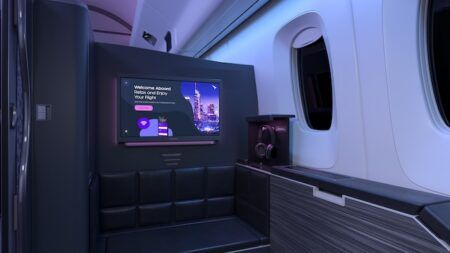
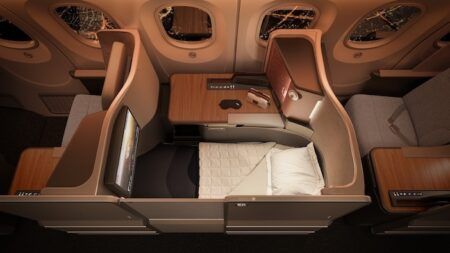
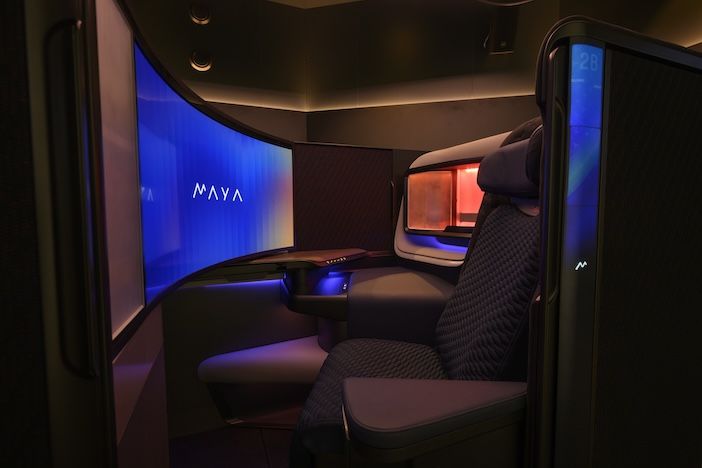
These principles are increasingly reflected in emerging cabin concepts. Rowan points to MAYA, a seating concept developed by PriestmanGoode in collaboration with Collins Aerospace and Panasonic Avionics, which takes a multi-layered approach to comfort, from spatial elements like privacy and cocooning, to multi-sensory design spanning lighting, acoustics and temperature, and digital features that enable interaction and pre-journey familiarisation.
Technology is playing a key role in enabling this shift. As Renat Anpilogov, co-founder of Your Accessible Flight, highlights, “Today, many staff members still need to search through manuals to answer accessibility questions.”
Digital tools that provide “quick and reliable guidance” not only support frontline teams, but also reduce uncertainty for passengers, creating a more seamless onboard experience, adds Anpilogov.
Your Accessible Flight is an iOS app designed to help travellers with disabilities, particularly wheelchair users, to plan and manage air travel for a barrier-free experience.
Rowan also highlights the rise of ‘shy tech’, meaning intuitive, low-visibility systems that minimise visual clutter and help create a calmer, more residential feel in the cabin. Combined with broader trends around wellness and personalisation, the direction of travel is clear.
As she puts it: “Making experiences work better for those with complex needs has the power to improve them for everyone. Who wouldn’t appreciate a greater sense of control, predictability, immersive calm, and cocooning comfort?”

Beyond the cabin
While cabin design sets the tone for passenger comfort, the rest of the journey often determines whether that experience truly succeeds.
Craig Kennedy highlights some of the most common pain points for neurodivergent travellers, including “loud and crowded airports, waiting in long lines, and being very uncomfortable during the screening process.” These moments can be particularly stressful, but they are also the moments where targeted interventions can make a meaningful difference.
Initiatives such as TSA Cares are one example. “You can set up a private screening… and a TSA agent will even meet you outside of security to help you through the process,” Kennedy explains, pointing to the value of a calmer, more predictable experience.

There is also a growing focus on the physical environment of airports. “While most major airports now have some kind of sensory or quiet room… many more are also still being added,” Kennedy says, noting that increasing attention is being placed on making these spaces easier to access throughout the journey.
For Anpilogov, however, the key to true accessibility lies in addressing moments of uncertainty. “The biggest opportunity appears in moments of uncertainty, such as check-in, security, boarding and transfers,” he says. “Clear information, predictable processes and well-trained staff benefit almost everyone.”
Lessons he sees from mobility accessibility are particularly relevant here. “When passengers know in advance what assistance is available, and what the process will look like… anxiety is significantly reduced,” he explains. “The same principle applies to neuroinclusive travel.”
Small, practical changes, from clearer pre-travel communication to consistent assistance procedures, can have an outsized impact. And, as Anpilogov notes, the long-term goal is more ambitious: “Accessibility should be integrated into the passenger journey from the start… making the experience smoother, more predictable, and more inclusive for everyone.”
Designing for everyone
Across cabin design, airport operations and enabling technology, there is a consistent message: designing for neurodiversity is not just about creating separate solutions, but about improving the core experience.
As Kennedy puts it, “Customer service is customer service… neurodiversity shouldn’t have anything to do with it.”
By reducing uncertainty, increasing personalisation and embedding accessibility into every stage of the journey, the aviation industry has an opportunity to deliver a more intuitive, more inclusive experience for all passengers. In doing so, it is not only responding to changing expectations, but redefining what great passenger service looks like, for everyone who travels.
A place for solutions
Neurodivergence will be a theme of this year’s Aircraft Interiors Expo (AIX), taking place from 14–16 April 2026 at Hamburg Messe in Germany.
The Passenger Experience Conference (PEC), taking place on 13 April, will provide several expert-led sessions focused on accessibility and designing for diverse needs. The expo will include several innovations that can make air travel more accessible for all, and the event itself is designed to make every attendee feel welcome, through accessibility features including a dedicated quiet room away from the crowds.