
Dassault Aviation has unveiled the Falcon 10X, which the French aerospace company is hailing as “its most ambitious business jet ever” and “a bold new benchmark for the future of long-range business aviation”. The aircraft was revealed at an event in a new production hall in Bordeaux-Mérignac, in front of more than 400 customers, partners and senior figures in aviation.
The planned entry into service of 2025 for the aircraft was delayed due to supply chain issues, with the new target being late 2027 to 2029, following its flight testing programme.

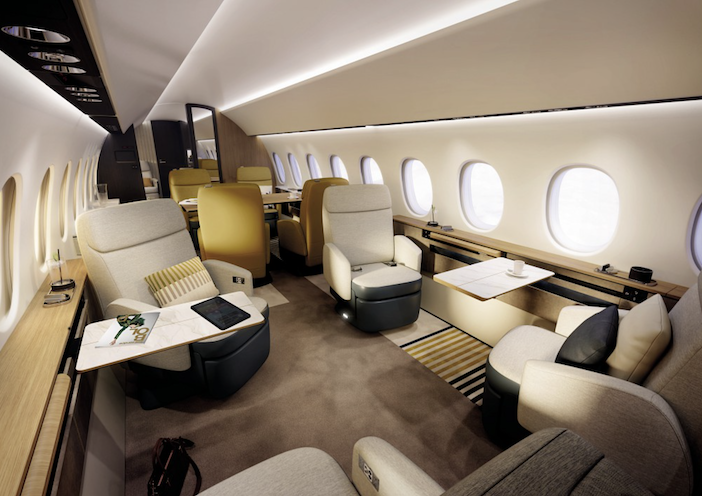
The headline feature of the Falcon 10X is its interior. Its 2,780 cubic feet of cabin volume is claimed by Dassault to enable the largest, most comfortable, and most versatile cabin ever fitted in a purpose-built business jet.
The cabin interior measures 9 feet, 1 inch wide (2.77 m) and 6 feet, 8 inches tall (2.03 m), making it larger than the cabins of some regional jets, and eight inches wider and two inches taller than its nearest competitor. Dassault has not specified what it regards as the nearest competitor to the Falcon 10X, but it is likely to be the Bombardier Global 7500/8000 or Gulfstream Aerospace G700/G800.
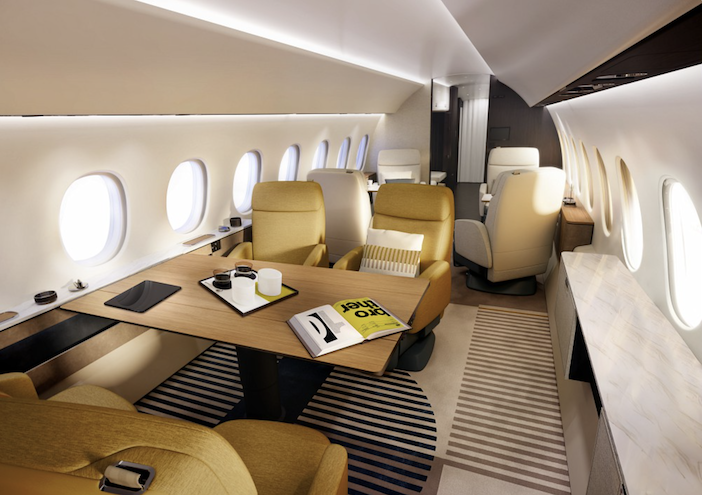
The spacious cabin is designed to enable owners to create interiors that feel less like a traditional aircraft cabin and more like a modern living or working environment. Customers can configure three- or four-zone interiors, including dining areas, Falcon Privacy Suites, full-size bedrooms, and even optional shower installations.
The 10X’s all-new fuselage has 38 extra-large windows, each nearly 50% larger than those on the Falcon 8X, enabling natural light to pass throughout the cabin. The fuselage has also been engineered to maintained cabin pressure of 3,000 feet at a cruising altitude of 41,000 feet, with 100% fresh air continuously renewed throughout the cabin and its individually adjustable temperature zones.
You can watch a video of a concept 10X cabin interior HERE.
“The objective,” said Dassault’s president and CEO Eric Trappier at the reveal, “is to allow passengers to experience time on board the aircraft as just another part of their everyday life, not as a long interval between origin and destination. So they arrive feeling refreshed and at their very best.”

Efficient performance
Dassault is the only manufacturer in the world that designs and builds both advanced fighter jets and business aircraft, which has created cross-disciplinary advantages in the engineering of the Falcon 10X in terms of aerodynamics, materials, avionics and flight controls.
The Falcon 10X is propelled by the new Rolls-Royce Pearl 10X engine featuring the Advance2 engine core, combined with a high-performance low-pressure system for thrust of more than 18,000 lb, with low noise and emissions for airport accessibility.
Dassault says the Falcon 10X will be able to cruise at speeds approaching the sound barrier, with a top speed of Mach 0.925. The aircraft is also expected to have a maximum range of 7,500 nm, allowing it to connect popular city pairs such as New York to Shanghai, Los Angeles to Sydney, São Paulo to Dubai, or Beijing to Paris.
Another key feature of the Falcon 10X design is its all-composite wings – the first in business aviation. The advanced structure combines traditional Dassault high-lift devices (slats and flaps) with a next-generation composite architecture designed to improve aerodynamic efficiency while reducing weight. The result is a wing that supports the aircraft’s large cabin while maintaining agility and runway flexibility.
An advanced cockpit
The Falcon 10X also introduces the NeXus flight deck, which in another superlative, is marketed by Dassault as being the most advanced cockpit ever installed in a business jet.
The NeXus cockpit is designed to reduce pilot workload and enhance situational awareness, especially during demanding phases of flight, with integrated large touch-screen displays featuring new automation tools that help crews manage complex missions. A standard dual FalconEye Enhanced Vision system adds further safety and capability in low visibility conditions, with new features to help during complex manoeuvres, such as night circling approaches.

The Falcon 10X also introduces the third generation of Dassault’s digital flight-control system in a business aircraft. The integrated Smart Throttle system, inspired by the controls of Dassault’s Rafale fighter jet, automatically manages both engines through a single control while assisting pilots with functions such as noise-abatement climbs and stabilised go-arounds.
The company claims that these combined digital capabilities make possible the first automatic recovery mode in a large business jet.