

With the rate at which modern technologies are being introduced and contemporary technologies are evolving, it is nearly impossible to predict what aircraft cabins will look like 50 years from now. Or is it?
Once you recover from the shock of realising that going back 50 years is only going back to 1976, you will find that many of today’s technologies were at least in the embryonic stages of ideation or development at that point.
Video calling was famously demonstrated in 1968’s sci-fi classic 2001: A Space Odyssey. The first internet existed in 1969, with the TCP/IP standard following in 1983.
Artificially intelligent robots were a mainstay in our visions of the future, seen in sci-fi movies and literature, pop culture, and the science and technology industries.
It is likely that two conditions exist presently with regard to how aircraft interiors will evolve when the calendar reads 2076. Firstly, concepts just coming to life now will be fully matured and integrated into every aspect of life (see AI and robotics). And also, many new technology breakthroughs will displace entire industries that dominate the market today (see landline telephones in 1976).
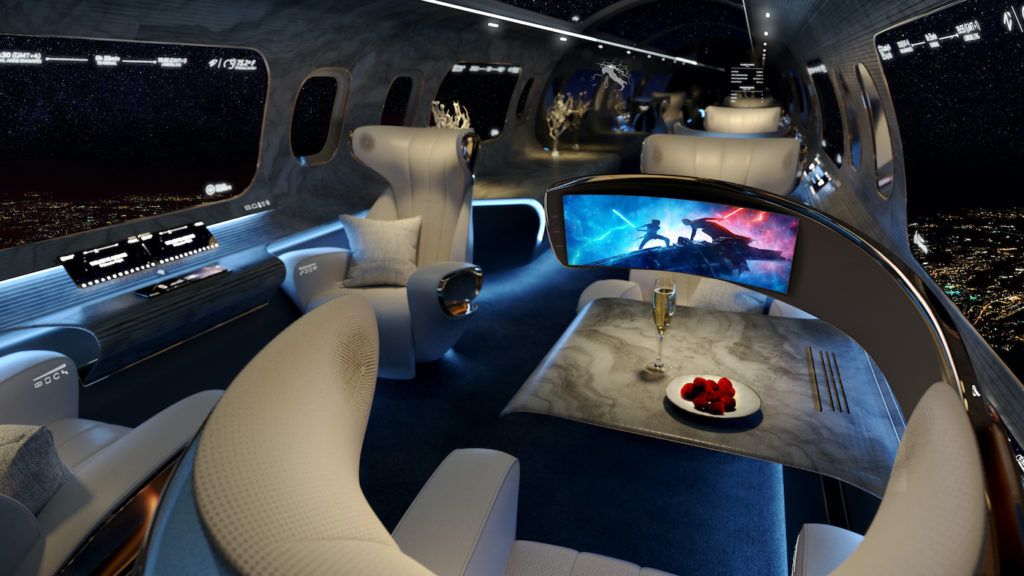
Artificial Intelligence (AI) and robotics are a certainty, and any bet on AI personal assistants, automated smart functionality, and dynamic multi-purpose cabin environments comprised of AI machines is a safe wager. Furthermore, tomorrow’s aircraft cabin will be significantly more connected in a variety of unique and novel ways, such as digital windows with point-of-interest information, and it will be much quieter.
The net effect will be a cabin that fosters relaxation and productivity equally, while still maintaining a seamless experience for a diverse array of travellers.
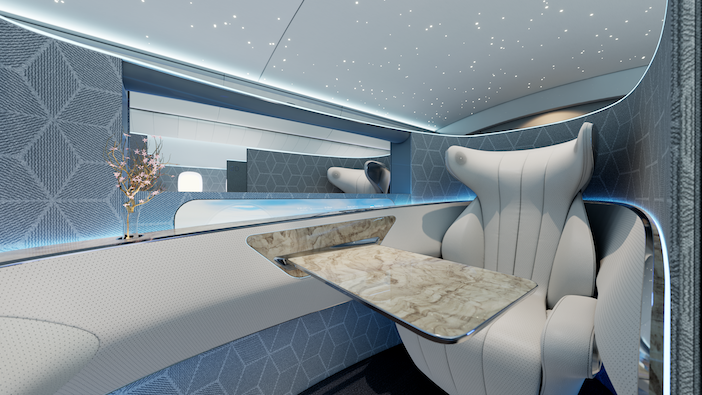
Rosen Aviation is already in the process of developing AI avatars, digital windows and skylights, and immersive in-seat AudioSpheres that encapsulate flyers in a personalised sound bubble. We call this collection of technologies PO-RT-AL (Personally Optimized – Real Time – Augmented Luxury).
As the name suggests, passengers are transported via a portal to any time or place of their choosing, enveloped by carefully curated technologies that engage their every sense.
Along with improvements to comfort and effectiveness, supporting AI technologies provide another key benefit that will shape tomorrow’s passenger experience: the concept of mission morphing. AI-powered cabin systems will infer passenger-focused decisions based on behavioural trends, biometric feedback, a plethora of sensors, and more, removing the need for designers and architects to compromise effectiveness for comfort, or comfort for effectiveness.
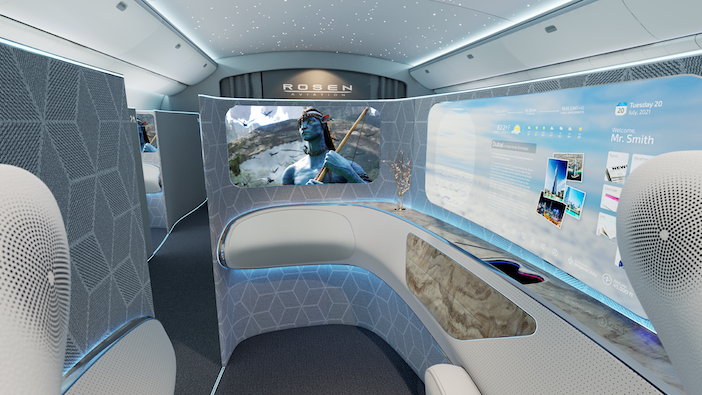
Ultra-powerful AIs, robotic devices, modular fixtures, and dynamic monuments will create a neural cabin network that can constantly adjust the physical environment to perfectly fit whatever the travel moment calls for.
Imagine a video conference with key business partners is set to begin. The window shades and lighting dim. The seating automatically rearranges to a conference room configuration based on the number of participants. The digital window showing the world passing by below seamlessly transitions to becoming a video conference screen.
Your AI digital assistant avatar is present, taking notes and offering business decisions based on current stock trends and past market data.
Once the meeting concludes, the lighting shifts to a warmer temperature, the conference room seating quietly shifts to lounge chairs and spa tables, and the cabin audio system provides a harmonious mix of birds chirping or waves crashing, all before a full-service robotic massager begins a much-needed shoulder rub. This is the power of mission morphing.
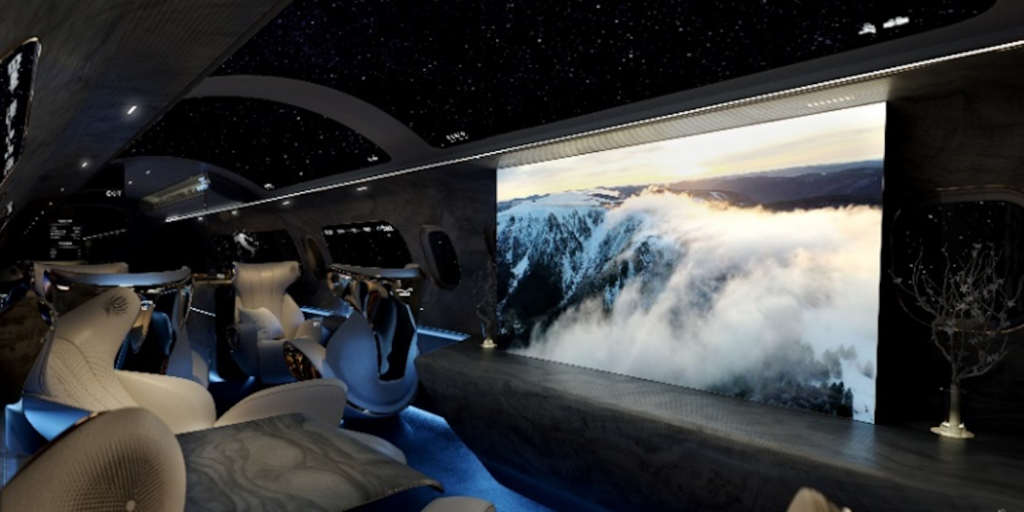
Looking at technologies that won’t survive offers more clues to what the future holds. We have already seen how personal devices upended the IFE landscape a decade ago, and continuous evolution may again render certain foundational tech obsolete.
For starters, any system not comprised of an IP Ethernet backbone will become increasingly ineffective over time. New system backbone protocols might emerge, and it is crucial that the principles of MOSAIC (Modular Open Source Architecture In Cabin) are widely accepted by system and component providers so that whichever system architecture is most viable, the cabin environment remains flexible and agnostic.
MOSAIC allows OEs, Tier Ones, integrators, system providers, and sub-tier suppliers all to thrive in a common, scalable ecosystem. The largest benefactor of MOSAIC system principles are passengers, who stand to enjoy a much broader, specially crafted range of options thanks to a greater diversity in cabins and cabin amenities.
Taking this concept further, agile system architectures pave the way for greater integration with non-fixed personal ‘carry-on’ devices. Now generally limited to phones, tablets, laptops and smart watches, the list of common devices will soon include smart glasses like Meta/Ray-Ban and other wearables, compact Edge-computing devices with Cloud access for unlimited connectivity, and personal robotic aids.
Where smart homes currently benefit from open systems built on common backbones, aircraft cabins will follow suit now and into the future, setting the stage for a dramatically enhanced passenger experience that we’re only just beginning to turn from imagination into reality.