

The onboard food and beverage (F&B) offer has become one of the most strategically important retail categories for airlines. While duty-free retail once dominated airlines’ ancillary revenue opportunities, the focus has widened to capture passengers throughout their entire journey.
At the same time, airlines are facing rising passenger expectations, operational pressures, and sustainability targets. The industry is increasingly turning to data and AI to move from static provisioning to predictive retailing.
From estimation to predictive retail
Historically, onboard menus were planned months in advance and loaded based on averages rather than insight. Today, predictive analytics software is reshaping this model. By combining historical sales, passenger loads, seasonal trends and route characteristics, AI-driven models can forecast demand with far greater accuracy.
Paul Bilham, chief commercial officer at Immfly, a specialist in onboard retail technology, explains how predictive analytics is changing onboard retail: “AI models can combine historical sales, booking data and external factors such as seasonality to predict demand at the item level. This reduces waste, prevents stockouts, and ensures the right balance of meals is loaded.”
This shift is no longer limited to fresh food. Predictive analytics is increasingly applied to ambient products, bar assortments, and wider retail categories. As Colin McKenna, director of innovation and strategic partnerships at Retail inMotion, also a specialist in the sector, adds, “We are seeing models that were traditionally used for inflight packing now being extended further up the supply chain to the ordering and warehousing of stock in order to avoid the over or under stocking of goods ahead of the inflight loop.”
The result, says McKenna, is tangible bottom-line impact alongside improved passenger satisfaction.
Pre-ordering as the path to scalable personalisation
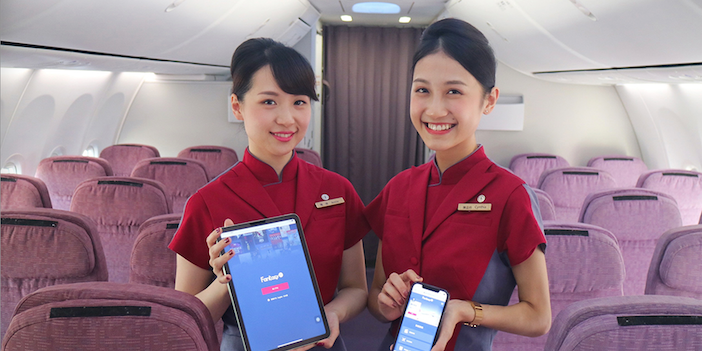
Among all digital tools available to the onboard F&B sector, pre-order stands out as the most effective and economically viable form of personalisation at scale. Yet it remains underutilised across the industry.
“The biggest opportunity lies in pre-ordering,” says Kai Kosicki, founder of ExpAir, an onboard experience consultancy. “By using data to move the latest point of order as close as possible to the departure of the flight, airlines can significantly improve personalisation, fulfilment accuracy, and overall passenger satisfaction.”
Pre-order also creates anticipation. Giving passengers the ability to select their meal in advance extends engagement beyond the cabin and sets clear expectations. However, trust is critical. Airlines must prioritise fulfilment and fairness before maximising incremental revenue. A balanced approach that combines included options with premium choices available for a surcharge allows airlines to generate additional revenue without undermining the customer experience.
Balancing standardisation and choice
Operational reality still defines what is possible onboard. For mass transport, particularly in economy class, airlines will continue to rely on standardised base offerings in order to control cost and complexity.

As Kosicki explains, “For mass transport, particularly in economy class, airlines are likely to continue to rely on a highly standardised base offering, enhanced through a robust pre-order system and a curated selection of food and beverage items available for purchase onboard.”
This approach allows airlines to deliver meaningful choice without disrupting cabin operations.
Dynamic menu creation – adapting assortments by route, season, or passenger mix – is increasingly becoming the direction of travel. According to Paul Bilham, “Dynamic menus are becoming standard as airlines tune assortments by route, season, aircraft and passenger mix.” However, operational constraints such as galley space and crew workflows will continue to set practical limits.
Integration and sustainability
Despite the promise of data-driven retail, integration remains the industry’s biggest challenge. Passenger data is often fragmented across booking systems, loyalty platforms, airport retail, and onboard sales tools. Without a central and uniform system, personalisation risks becoming superficial and harmful to passenger loyalty.
“The key is a unified data platform,” says Bilham from Immfly, noting that bringing these data sources together enables “a single passenger view that powers real-time insights, retail forecasting, and personalised engagement across the journey.”
Better data integration also delivers clear sustainability benefits. “Predictive provisions mean fewer wasted meals, lighter aircraft and lower emissions,” Bilham explains, adding that this also transforms catering from estimation into intelligence.
As Colin McKenna puts it, personalisation ultimately comes down to execution: “Having the relevant products on board the right aircraft at the right time for sale, they’ll end up in a satisfied passengers’ hands and ultimately drive better the Net Promoter Score (NPS) for the airline.”
Evolving passenger expectations
What passengers expect from onboard food and beverage has changed. Healthy eating isn’t a special request anymore − it’s a standard offer. Protein-rich meals, plant-based alternatives, and lower-sugar options appear on most menus now, driven as much by sustainability concerns as dietary preferences.
Kai Kosicki, who is also the Retail Technology Ambassador for WTCE (World Travel Catering and Onboard Services Expo), notes that this evolution reflects a more informed consumer mindset: “Passengers are becoming far more conscious of food origin, processing, ingredients, and sustainability. Meanwhile, the demand for personalised experiences has grown significantly. Passengers want the ability to create their own menu, pick and choose according to their preferences, and to be able to do so without a substantial increase in price.”
Generational differences are also becoming more pronounced. Gen Z passengers tend to prioritise health, sustainability and customisation, while Millennials look for a balance between quality, value and freshness. Gen X travellers, meanwhile, often favour familiar, filling meals. Addressing these diverse expectations at scale requires a more intelligent approach than traditional menu planning.
Looking ahead
Data analytics will play an even greater role in shaping onboard dining over the next decade. Advances in shelf-stable and dehydrated food could allow aircraft to carry a wider range of options without increasing weight or waste. Combined with pre-order and real-time connectivity, airlines will be able to match supply far more closely to individual preferences.
Ultimately, the goal is not complexity, but relevance. As McKenna from Retail inMotion concludes, “The key for the industry will be joining the data dots to get to ‘relevance’ – not just personalisation – in the next three to five years.”
In the age of AI, predictive retailing offers airlines a powerful way to drive ancillary revenue while building trust, loyalty, and long-term differentiation.