


Hexagon, a supplier of measurement technologies, has developed a rapid-delivery reverse engineering workflow for aviation maintenance, repair and overhaul (MRO) teams, designed to remove the risk of fit-and-rework when replacing a part that has no available CAD data.
On-demand manufacturing is becoming a popular option for reproducing ageing aircraft cabin interiors with cracked, delaminated, or obsolete parts such as seat shrouds, armrests, tray tables, galley doors, latches and hinges. However, when there is no CAD data available for the parts then the process becomes slower.
Scan-based reverse engineering makes it easier to replicate a part, avoiding the risk of errors that arise from manual feature measurement or outdated drawings. However, this process can be slow, requiring specialist CAD and scanning skills to redraw a usable 3D model from an incomplete scan.
According to Hexagon, non-specialist CAD software can compound the time delays. Its solution, developed by its Portable Metrology Division, is Geomagic Design X, which combines direct handheld 3D scanner control with automated software tools such as Region Segmentation, Modelling Wizards, and Auto Sketch, plus NURBS (non-uniform rational B-spline) surfacing.
The company says the system can turn even complex, freeform shapes into fully editable, parametric CAD models with complete history. The company says the system can rebuild an accurate model three to eight times more quickly than with scan-based reverse engineering.
Aziz Tahiri, global director, aerospace and defence at Hexagon explained: “Reverse engineering is becoming indispensable for interior refurbishment, and we are seeing rising interest from defence customers in mobile units that combine a scanning arm, reverse engineering software and a 3D printer in one container, so a damaged part can be scanned, rebuilt and repaired on site.
“But in practice, reverse engineering even a single mechanical component is often a laborious process that might involve several people, unreliable results and manual repair. With Geomagic Design X and accessible 3D scanning equipment like Hexagon’s new handheld scanners, we are making it feasible to reverse engineer directly back into CAD in a matter of hours. It’s a highly productive workflow that engineers and manufacturing teams can easily adopt.”
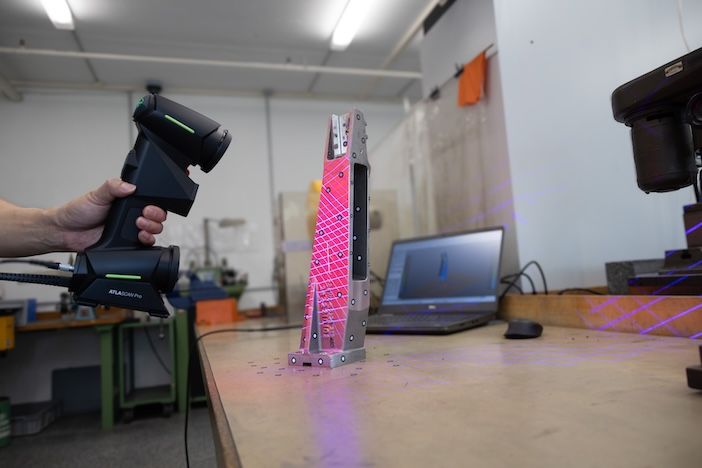
Hexagon says that MRO technicians and manufacturing engineers don’t need specialist training to scan for the reverse-engineering process. Its rugged and portable Atlascan Pro scanner enables users to scan small parts, such as damaged seat components, from any angle, even in unstable hangar, shopfloor or field conditions, capturing missing details and high-density data.
The Accuracy Analyzer feature of the reverse-engineering software checks constructed surfaces against the scan data at every stage, reducing the risk of rework, tooling iterations and fit issues. The finished model is then sent by LiveTransfer directly into the client’s CAD software, whether that’s Solidworks, Siemens NX, Autodesk Inventor, or PTC Creo.
This accurate input data enables fast reverse engineering and a high-quality output part, whether it is machined or 3D printed, with less trial-and-error or manual rework before a replacement part is suitable to be fitted in the cabin.